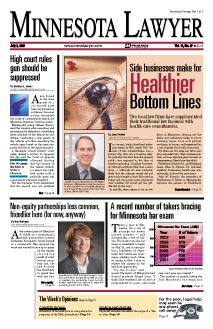
The Justice Department will not try to prevent Congress from granting immunity to a former department official to testify about the firing of eight federal prosecutors, the Pioneer Press reports on its website.
In a letter to House Judiciary Committee Chairman John Conyers, D-Mich., officials from two Justice Department offices investigating whether the department played politics when hiring prosecutors said they would prefer not to see the department's former White House liaison, Monica Goodling, given immunity.
"However, we understand the committee's interest in obtaining Ms. Goodling's testimony," the letter said. "Therefore after balancing the significant public interest against the impact of the committee's actions on our ongoing investigation, we will not raise an objection or seek a deferral."
For more, click here.
Monday, May 7, 2007


Strib to reduce workforce by 145
The Strib just posted this:
The Star Tribune announced plans Monday to reduce its workforce by about 145 employees across the company, primarily through voluntary buyouts. Editor Nancy Barnes said she will be restructuring the newsroom and will operate with about 50 fewer employees. Click here for more.
I wish had a way to put a good a face on this, but there just isn't. The entire state will be impacted by these short-sighted cuts. The bloodletting was not unexpected, but is unfortunate nonetheless.
The Star Tribune announced plans Monday to reduce its workforce by about 145 employees across the company, primarily through voluntary buyouts. Editor Nancy Barnes said she will be restructuring the newsroom and will operate with about 50 fewer employees. Click here for more.
I wish had a way to put a good a face on this, but there just isn't. The entire state will be impacted by these short-sighted cuts. The bloodletting was not unexpected, but is unfortunate nonetheless.
Pawlenty expected to sign public safety bill
The Star Tribune today notes that a bill providing $2 billion for prisons, courts and the Department of Public Safety has a high level of support at the Capitol. The measure would also provide $3.4 million for services to battered women and children and $2 million to put more police on city streets.
After DFLers removed a controversial provision on litigation over insurance claims, the bill passed the Senate 65-0 and the House 124-6. Gov. Tim Pawlenty said he will sign it next week, the Strib reports.
After DFLers removed a controversial provision on litigation over insurance claims, the bill passed the Senate 65-0 and the House 124-6. Gov. Tim Pawlenty said he will sign it next week, the Strib reports.
Strib columnist back on the beat
An update on a prior post ("Strib columnists may be Par-ed back"), Strib metro columnist and veteran blogger James Lileks reports on his blog today that "they've killed my column, and assigned me to write straight local news stories."
In related(?) news, the Rake reports that the Strib has scheduled an ominous 3:00 p.m. meeting for today in which staff reductions and/or additional voluntary-buyout opportunities may be announced. (Click here for more.)
In related(?) news, the Rake reports that the Strib has scheduled an ominous 3:00 p.m. meeting for today in which staff reductions and/or additional voluntary-buyout opportunities may be announced. (Click here for more.)
Overhauling judicial elections
After finally sifting through the 58-page Quie Commission report (which was issued in late March), I am still not 100 percent sold on the majority's recommendation that Minnesota adopt a retention system for judicial elections. (Under a retention system, voters cast a ballot on whether or not a judge should be retained; this differs from our current system, which allows challengers to run against specific judges.)
While retention elections stop someone from getting elected to the bench by using politics or money from special interest groups, they do not keep someone from getting voted off the bench after political or special interest groups finance "do not retain this judge" campaigns. Moreover, judges may not know whether they will have to raise money to fend off such a campaign until it is too late.
The minority position was to convert Minnesota to a pure appointment system whereby the governor would make the selection from a list of candidates presented to him by merit-selection commission. Of course, this approach eliminates direct accountability to the people through the ballot box.
Other alternatives include leaving things as they are (which runs the risk of allowing highly politicized judicial elections in Minnesota) or having some sort of legislative involvement in the process, as committee member Eric Lipman posits in his own intriguing proposal. (I have to put some more thought into this one.)
All of the major alternatives have some pretty sizable drawbacks, so I find myself still pondering the correct course. There are no easy answers here. To paraphrase Winston Churchill's famous axiom about Democracy, I think we will have to go with the option that is the worst -- with the exception of all the other options, that is.
While retention elections stop someone from getting elected to the bench by using politics or money from special interest groups, they do not keep someone from getting voted off the bench after political or special interest groups finance "do not retain this judge" campaigns. Moreover, judges may not know whether they will have to raise money to fend off such a campaign until it is too late.
The minority position was to convert Minnesota to a pure appointment system whereby the governor would make the selection from a list of candidates presented to him by merit-selection commission. Of course, this approach eliminates direct accountability to the people through the ballot box.
Other alternatives include leaving things as they are (which runs the risk of allowing highly politicized judicial elections in Minnesota) or having some sort of legislative involvement in the process, as committee member Eric Lipman posits in his own intriguing proposal. (I have to put some more thought into this one.)
All of the major alternatives have some pretty sizable drawbacks, so I find myself still pondering the correct course. There are no easy answers here. To paraphrase Winston Churchill's famous axiom about Democracy, I think we will have to go with the option that is the worst -- with the exception of all the other options, that is.
Sunday, May 6, 2007
Anniversary of the Hindenburg disaster
Seventy years ago today the 804-foot-long German dirigible Hindenburg met its fiery end in Lakehurst, N.J. ("Survivors Remember Hindenburg's Fiery End.")
A total of 35 people on board and one person in the ground crew died in the tragedy; 62 passengers and crew members survived.
Flammable hydrogen had to be used because of a U.S. embargo on nonflammable helium to Germany. The cause of the disaster is still debated. The most accepted theory is that static electricity from the day's storms ignited leaking hydrogen.
One wonders if such an incident were to occur today how massive the lawsuits would be. The people who were killed died horribly, mostly burning to death. More than 1,000 sightseers were watching as the vessel exploded into a ball of fire. The survivors still vividly recall it seven decades later.
A total of 35 people on board and one person in the ground crew died in the tragedy; 62 passengers and crew members survived.
Flammable hydrogen had to be used because of a U.S. embargo on nonflammable helium to Germany. The cause of the disaster is still debated. The most accepted theory is that static electricity from the day's storms ignited leaking hydrogen.
One wonders if such an incident were to occur today how massive the lawsuits would be. The people who were killed died horribly, mostly burning to death. More than 1,000 sightseers were watching as the vessel exploded into a ball of fire. The survivors still vividly recall it seven decades later.
Saturday, May 5, 2007
Has Yale Law slipped in the rankings?
I came across the following correction in the Strib:
Correction
A May 3 letter in some papers incorrectly stated that Rachel Paulose, U.S. attorney for Minnesota, attended a "tier four" law school. She attended Yale.
Hmmm. I would think Yale would at least be considered a "tier 3" school.
Correction
A May 3 letter in some papers incorrectly stated that Rachel Paulose, U.S. attorney for Minnesota, attended a "tier four" law school. She attended Yale.
Hmmm. I would think Yale would at least be considered a "tier 3" school.
Debate over big-firm associate pay
The following is an excerpt from a column by Ed Poll on the affect of skyrocketing associate salaries that will appear in Monday's Minnesota Lawyer.
The news has been the talk of the legal world: average first-year associate pay at the mega-firms has exploded to more than $160,000.
Some commentators say this opens up tremendous opportunity for smaller firms with a more “rational” pay structure.
General counsel at company after company declare that they will not pay for such outrageous salaries when it comes to their legal work.
Of course, with the average lawyer in small firm or solo practice making $60,000 a year or less, this seems a tempest in a far-removed teapot.
But the debate over big-firm associate pay is important because of what it says about our profession and our society.
There’s no doubt that high associate pay is here to stay for the mega-firms. With the competition for top law school talent so fierce, and with profits per partner at the 100 largest firms averaging more than $1 million annually, it’s a given that the cost of legal talent is bound to rise. ...
Associate salaries may be high, but if compared to equity partners’ revenue, the percentage is actually lower today than it was only a few years ago. If associates are making so much money, partners are too.
The news has been the talk of the legal world: average first-year associate pay at the mega-firms has exploded to more than $160,000.
Some commentators say this opens up tremendous opportunity for smaller firms with a more “rational” pay structure.
General counsel at company after company declare that they will not pay for such outrageous salaries when it comes to their legal work.
Of course, with the average lawyer in small firm or solo practice making $60,000 a year or less, this seems a tempest in a far-removed teapot.
But the debate over big-firm associate pay is important because of what it says about our profession and our society.
There’s no doubt that high associate pay is here to stay for the mega-firms. With the competition for top law school talent so fierce, and with profits per partner at the 100 largest firms averaging more than $1 million annually, it’s a given that the cost of legal talent is bound to rise. ...
Associate salaries may be high, but if compared to equity partners’ revenue, the percentage is actually lower today than it was only a few years ago. If associates are making so much money, partners are too.
Friday, May 4, 2007
Strib columnists may be Par-ed back
There is an interesting posting on the Rake's website today.
"Thursday afternoon at the Star Tribune saw the paper's four metro columnists, Doug Grow, Nick Coleman, Katherine Kersten and Cheryl 'CJ' Johnson called in to separate meetings with editors Nancy Barnes and Scott Gillespie and told, in so many words, that the paper was looking to scale back the number of columnists and would any of them care to raise their hands and volunteer for reassignment to the paper's suddenly thin -- and getting thinner -- ranks of street-level reporters?" Click here for more.
Hmm. Perhaps Par Ridder will be tapping out some columns himself -- assuming he has found a replacement laptop.
In all seriousness, I hope that the Strib does not fall victim to the major bloodletting everyone has anticipated since the new owners took over. Unfortunately, in this case I fear that the conventional wisdom may be right ...
"Thursday afternoon at the Star Tribune saw the paper's four metro columnists, Doug Grow, Nick Coleman, Katherine Kersten and Cheryl 'CJ' Johnson called in to separate meetings with editors Nancy Barnes and Scott Gillespie and told, in so many words, that the paper was looking to scale back the number of columnists and would any of them care to raise their hands and volunteer for reassignment to the paper's suddenly thin -- and getting thinner -- ranks of street-level reporters?" Click here for more.
Hmm. Perhaps Par Ridder will be tapping out some columns himself -- assuming he has found a replacement laptop.
In all seriousness, I hope that the Strib does not fall victim to the major bloodletting everyone has anticipated since the new owners took over. Unfortunately, in this case I fear that the conventional wisdom may be right ...
Minnesota trial lawyer's group changes its name
The American Association for Justice took some flack in the media last summer when it changed its name from the American Association of Trial Lawyers (ATLA), which it had been known as since 1972. Nonetheless, it looks like the Minnesota Association of Trial Lawyers (MTLA) has followed suit and changed its name to the Minnesota Association for Justice (MAJ).
Half of the independent state trial lawyers groups have made a similar change, while many others are still considering it. According to Minneapolis attorney Chris Messerly, president of the MAJ, the new name was approved in Minnesota last month. Messerly said the reason for the change was that members wanted to be identified by what they do, not by what they are.
Look for a Bar Buzz item on this name change in Monday's Minnesota Lawyer.
Half of the independent state trial lawyers groups have made a similar change, while many others are still considering it. According to Minneapolis attorney Chris Messerly, president of the MAJ, the new name was approved in Minnesota last month. Messerly said the reason for the change was that members wanted to be identified by what they do, not by what they are.
Look for a Bar Buzz item on this name change in Monday's Minnesota Lawyer.
Insurance bill a matter of faith
The Strib has an update on the good-faith insurance bill that allows direct actions against insurers and creates a cause of action against insurers who deny benefits without a reasonable basis.
Through an amazing act of legislative prestidigitation, the insurance bill was attached to a $2 billion public safety bill. Gov. Tim Pawlenty, who is against the insurance measure, threatened to veto the entire public safety bill unless the insurance rider was removed.
"During debate in the Senate and the House, supporters angrily accused Pawlenty and the insurance industry of refusing to compromise," the Strib reports. "The bill has been the target of extensive lobbying from the trial lawyers, who long have primarily supported DFLers, and of an expensive media campaign from the insurance industry, which has often supported Republicans."
The insurance provision was ultimately pulled to make way for the massive public-safety bill. (See "'Good faith' starts slugfest at Legislature.") It wil undoubtedly resurface again a separate piece of legislation.
The entire episode proves what I always have thought: "If laws are like sausages, stick with vegetarian option." In any event, as I posted before, I am sick of those lawyer-bashing insurance industry radio ads against this bill. If they really want to keep our rates down, why don't they stop running that obnoxious and deceptive ad campaign and send the money saved back to us in the form of a rebate or reduced premium?
Through an amazing act of legislative prestidigitation, the insurance bill was attached to a $2 billion public safety bill. Gov. Tim Pawlenty, who is against the insurance measure, threatened to veto the entire public safety bill unless the insurance rider was removed.
"During debate in the Senate and the House, supporters angrily accused Pawlenty and the insurance industry of refusing to compromise," the Strib reports. "The bill has been the target of extensive lobbying from the trial lawyers, who long have primarily supported DFLers, and of an expensive media campaign from the insurance industry, which has often supported Republicans."
The insurance provision was ultimately pulled to make way for the massive public-safety bill. (See "'Good faith' starts slugfest at Legislature.") It wil undoubtedly resurface again a separate piece of legislation.
The entire episode proves what I always have thought: "If laws are like sausages, stick with vegetarian option." In any event, as I posted before, I am sick of those lawyer-bashing insurance industry radio ads against this bill. If they really want to keep our rates down, why don't they stop running that obnoxious and deceptive ad campaign and send the money saved back to us in the form of a rebate or reduced premium?
Thursday, May 3, 2007
Depoliticize Justice?
 In today’s op-ed pages of the New York Times, a former deputy attorney general presents a novel way of restoring confidence in the U.S. Attorney’s Office.
Rather than question whether Attorney General Alberto Gonzales should go or stay, the author argues that the attorney general shouldn’t be a cabinet position at all — it should be a fixed-term job, instead.
“Likewise, the 93 United States attorneys should not be political apparatchiks, but talented lawyers selected half from Republican ranks and half from Democratic,” Arnold I. Burns writes.
Click here for the full opinion piece, “Two Parties, One Law.”
FindLaw nets Webby
 Kudos to FindLaw for being named this week as the People’s Voice winner in the law category for the 2007 Webby Awards.
FindLaw is the attorney-locator service from publishing giant Thomson Corp., based in Eagan.
Now in its 11th year, the Webby’s are about the closest thing to an Oscar or Grammy for websites.
And as long as I’m chatting up Thomson, be sure to check out one of my favorite YouTube videos from Thomson’s legal research arm, Westlaw.
Remember, it’s up to you to prevent stress toy abuse.
Legendary criminal defense lawyer passes
Legendary Minnesota criminal defense attorney Doug Thomson has died after a lengthy illness. Thomson -- who tried many high-profile cases, including the T. Eugene Thompson murder trial in the 1960s -- was at one time widely recognized as one of the top people in his field.
Thomson's former partner, Hennepin County District Court Judge Jack Nordby, said of Thomson: "He was better than any lawyer I have ever known, with the exception of F. Lee Bailey, at giving a closing argument. I saw him win case after case that were just losers based on his closing argument."
Thomson's former partner, Hennepin County District Court Judge Jack Nordby, said of Thomson: "He was better than any lawyer I have ever known, with the exception of F. Lee Bailey, at giving a closing argument. I saw him win case after case that were just losers based on his closing argument."
Wednesday, May 2, 2007
Questions linger at AG's office
The simmering drama at the state attorney general's office reached a climax of sorts yesterday with the abrupt resignation of former attorney general Mike Hatch, but by no means did the saga reach its conclusion. In fact, Hatch's departure probably raised more questions than it answered:
-- Where will Hatch land? Given his reputation as a volatile personality, will a private firm be reluctant to take a chance on him? Or will his obvious legal skills overcome reservations about his demeanor?
-- What will Hatch's role be as the AGO moves forward? His status as a mentor to Lori Swanson is well known. Will he try -- and will he be allowed -- to pull strings behind the scenes?
-- What will change in the AG's office? According to some insiders, Lori Swanson, not Hatch, was the one spending 14-hour days vetting every bit of correspondence that went out of Bremer Tower. Will the new situation allow her to focus on the job she was actually elected to do?
-- With Hatch out and the AGO struggling to replace staff, will recent defectors be welcomed back? Will they want to come back?
-- How will this shake-up affect the office's credibility, if at all? Will the administrative dysfunction that's come to light affect the AGO's ability to effectively pursue important cases?
-- What of the two weeks' notice given by Hatch? Was he strictly following procedure, or will he see this as an opportunity to settle lingering scores before leaving?
-- What's to become of Swanson's political career? A man who nearly became governor was willing to fall on his sword for her. Is that a tribute to how she's being groomed for bigger things?
-- How will the Swanson-AFSCME drama play out? It was the pretext for the public airing of the AGO story to start with, and now it seems to have been placed on the back burner. Will the unionizing efforts in the office pan out, and will Swanson and local AFCSME leader Elliot Seide make peace?
As the AGO story disappears from mainstream news sources, it's easy to see these lingering questions as so much inside-baseball speculation that only law geeks would care about. But in fact, how it plays out from here might be the most important stage in the whole tale.
What do you think will happen?
Tuesday, May 1, 2007
Parting thoughts on Hatch's resignation
It would have been a much more dignified end for Mike Hatch's career as Attorney General if he had turned in his office keys four months ago like he was supposed to. And the man is in many ways a walking HR problem with anger-management issues, there is no denying that. However, properly channeled, some of his worst qualities -- his aggressiveness, his single-minded determination, his anger and indignation -- could also be some of his best qualities.
He did do the consumers of this state some service. I wouldn't want that forgotten because of his tardy exit from the AG's Office. When he was taking his hammer to unscrupulous lenders he was fine, but when he took it to his employees, he was out of line. I have heard Mr. Hatch compared to a bull dog, and that is an apt analogy. As AG, he was happiest when he was out chasing insurers or health-care providers on behalf of consumers. But when he was locked in the office, he would start to tear up the furniture. Eventually enough was enough, and it was time for him to go out.
I wish Mr. Hatch the best of luck in the private sector. I have no doubt that there is a job out there where he can put his energy and aggressiveness to good use. Meanwhile, I would call on AG Lori Swanson to make her office a place where the staff enjoys coming to work and serving the citizens of this state. They are dedicated public servants and deserve that.
He did do the consumers of this state some service. I wouldn't want that forgotten because of his tardy exit from the AG's Office. When he was taking his hammer to unscrupulous lenders he was fine, but when he took it to his employees, he was out of line. I have heard Mr. Hatch compared to a bull dog, and that is an apt analogy. As AG, he was happiest when he was out chasing insurers or health-care providers on behalf of consumers. But when he was locked in the office, he would start to tear up the furniture. Eventually enough was enough, and it was time for him to go out.
I wish Mr. Hatch the best of luck in the private sector. I have no doubt that there is a job out there where he can put his energy and aggressiveness to good use. Meanwhile, I would call on AG Lori Swanson to make her office a place where the staff enjoys coming to work and serving the citizens of this state. They are dedicated public servants and deserve that.
Hatch resigns
Former Attorney General Mike Hatch today resigned his post as director of complex litigation at the Attorney General's Office.

In a letter to AG Lori Swanson, Hatch said: "Because of my presence in your administration, it is apparent that changes I made during my administration are unfairly attributed to you. It is not appropriate you should become targets of complaints involving my administration. I hope that with this resignation the public will continue to focus on the good deeds you are undertaking on behalf of ordinary citizens.'' For more, click here. (Star Tribune)
The Pioneer Press has the full text of Hatch's resignation letter. Hatch is apparently giving two weeks notice, which strikes me as a bit odd given the situation.
In any case, I applaud Hatch's decision, which will allow Swanson to work on straightening out the longstanding management issues at the office and get back to serving the people of this state, which I believe she is capable of doing well.

In a letter to AG Lori Swanson, Hatch said: "Because of my presence in your administration, it is apparent that changes I made during my administration are unfairly attributed to you. It is not appropriate you should become targets of complaints involving my administration. I hope that with this resignation the public will continue to focus on the good deeds you are undertaking on behalf of ordinary citizens.'' For more, click here. (Star Tribune)
The Pioneer Press has the full text of Hatch's resignation letter. Hatch is apparently giving two weeks notice, which strikes me as a bit odd given the situation.
In any case, I applaud Hatch's decision, which will allow Swanson to work on straightening out the longstanding management issues at the office and get back to serving the people of this state, which I believe she is capable of doing well.
High speed chases: the movie
Yesterday’s U.S. Supreme Court decision in Scott v. Harris was notable for a couple of reasons: Most importantly, it established a bright-line rule for high-speed car chases by police: "A police officer's attempt to terminate a dangerous high-speed car chase that threatens the lives of innocent bystanders does not violate the Fourth Amendment, even when it places the fleeing motorist at risk of serious injury or death."
It also made jurisprudential history because the Supreme Court based its decision on a video of the incident, which left a 19-year-old man quadraplegic. In the majority decision, Justice Antonin Scalia said, “The record in this case includes a videotape capturing the events in question. Where, as here, the record blatantly contradicts the plaintiff's version of events so that no reasonable jury could believe it, a court should not adopt that version of the facts for purposes of ruling on a summary judgment motion.”
"We are happy to allow the videotape to speak for itself," Scalia said in a footnote, directing interested viewers to the court's website where there is a link to a video file next to the Scott v. Harris citation.
Justice John Paul Stevens dissented, saying that the video “surely does not provide a principled basis for depriving the respondent of his right to have a jury evaluate the question whether the police officers' decision to use deadly force to bring the chase to an end was reasonable.”
I’d be interested in your thoughts not only on the merits of the case but also on the Supreme Court’s role as fact-finder and its decision to post the video on the Web.
It also made jurisprudential history because the Supreme Court based its decision on a video of the incident, which left a 19-year-old man quadraplegic. In the majority decision, Justice Antonin Scalia said, “The record in this case includes a videotape capturing the events in question. Where, as here, the record blatantly contradicts the plaintiff's version of events so that no reasonable jury could believe it, a court should not adopt that version of the facts for purposes of ruling on a summary judgment motion.”
"We are happy to allow the videotape to speak for itself," Scalia said in a footnote, directing interested viewers to the court's website where there is a link to a video file next to the Scott v. Harris citation.
Justice John Paul Stevens dissented, saying that the video “surely does not provide a principled basis for depriving the respondent of his right to have a jury evaluate the question whether the police officers' decision to use deadly force to bring the chase to an end was reasonable.”
I’d be interested in your thoughts not only on the merits of the case but also on the Supreme Court’s role as fact-finder and its decision to post the video on the Web.
Rosario: Hatch must go from AG's Office
The Pioneer Press's Rubén Rosario, who has been closely following the events at the Attorney General's Office, wrote a piece calling for Mike Hatch's removal. While commending Hatch for his service to the state, he said it's time for the ex-AG to move on.
Formatting the piece as a letter to Lori Swanson, Rosario says: "Your decision to bring Hatch back into the office, according to nearly a dozen current and former staffers, is the main reason why your office's public image, if not effectiveness, is sinking."
Rosario concludes his piece: "You mention Hatch can land a gig at a prominent law firm for substantially more money. Now's the time for Hatch to find that out. It's time to step up. Don't be like Mike. Just do it."
For the full article, see "One more employee at AG office needs to go" in today's Pioneer Press.
Formatting the piece as a letter to Lori Swanson, Rosario says: "Your decision to bring Hatch back into the office, according to nearly a dozen current and former staffers, is the main reason why your office's public image, if not effectiveness, is sinking."
Rosario concludes his piece: "You mention Hatch can land a gig at a prominent law firm for substantially more money. Now's the time for Hatch to find that out. It's time to step up. Don't be like Mike. Just do it."
For the full article, see "One more employee at AG office needs to go" in today's Pioneer Press.
Subscribe to:
Posts (Atom)