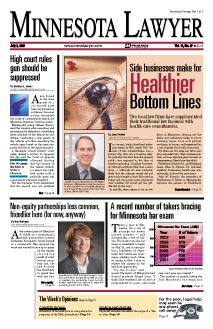
A couple of news stories lately have raised some questions about what the profession can expect from its new lawyers, and what new lawyers will be available.
Corporate Counsel reported last week that larger law firms are losing 30 to 50 percent of associates after three to four years -- with half to two-thirds of the defections due to associate, not firm, choice. “Where do they go? Smaller firms, more competitive firms in the same city, firms in other cities, in-house, government, teaching, nonlegal jobs,” the report said.
Money and perks are increasing at many of the big firms, but retention isn’t. The article says that associates find the profession disappointing and demoralizing, and recommends “coherent, systematic, up-front law firm investment in young lawyer development programs within the firm, not fancier recruiting restaurants, to develop skilled, energized lawyers who can, and will, provide longer-term value to the firm -- and to the profession.”
But what young lawyers?
A report on law school enrollment by the American Bar Association Section of Legal Education and Admissions to the Bar showed that total enrollment by students seeking the J.D. degree increased only slightly during 2007-08, while enrollment of first-year students was nearly flat, compared to the previous year.
Broken out by gender, the ABA report further reveals that total enrollment of male students increased slightly but first-year male enrollment dipped, and total enrollment by females decreased despite a rise in the number of women students in the entering class. Minorities posted slight gains.
Tuesday, March 4, 2008


Monday, March 3, 2008
Headline of the month
Every now and then an editor gets to have real fun with a headline. For your amusement I have an example of such a headline for you. It was brought to my attention by Chuck Williams, editor of the American Bar Association's Supreme Court Preview. In this case, the source bears mentioning not only because I like to give credit where credit is due, but also because it is the only legal connection to a posting I am putting up strictly for your enjoyment.
The headline comes from an Associated Press article spotted in the Washington Post. The story is about individuals who cross a Korean river on a wire as they use a pole to keep their balance. The precarious practice is called skywalking; the people doing it cross alone without any assistance; and the name of the river is the Han.
Now you be the editor. What headline would you assign to that story?
To see what headline was actually published, click here.
The headline comes from an Associated Press article spotted in the Washington Post. The story is about individuals who cross a Korean river on a wire as they use a pole to keep their balance. The precarious practice is called skywalking; the people doing it cross alone without any assistance; and the name of the river is the Han.
Now you be the editor. What headline would you assign to that story?
To see what headline was actually published, click here.
Criminal defense attorneys know how to have fun
While other types of lawyers may disagree, I have always felt that nobody knows how to have fun like criminal defense attorneys when they let down their hair.
As proof, I offer from this week's Bar Buzz column in Minnesota Lawyer the following intriguing silent auction items that the Minnesota Association of Criminal Defense Lawyers will offer at the group's annual shindig next week:
As proof, I offer from this week's Bar Buzz column in Minnesota Lawyer the following intriguing silent auction items that the Minnesota Association of Criminal Defense Lawyers will offer at the group's annual shindig next week:
- A weekend for four at attorney Carolyn Agin Schmidt’s beachfront home in Duluth;
- A 90-minute plane ride for three with attorney Jeff Sheridan;
- A New Orleans dinner for six cooked in your home by attorney Caroline Durham;
- Two 45-minute guitar/song sets by attorney Jim Sheehy at your next party;
- A guided kayak trip to the Apostle Islands with attorney Brock Hunter;
- A four-day stay in a three-bedroom Telluride Colorado Condo from attorney Fred Bruno. and
- A neon statue of Lady Justice to decorate your office window from attorney Mike McGlennen.
Republican National Convention will put free speech to the test
We are now six months away from the start of the Republican National Convention right here in Minnesota. (Hmmm. Will it be McCain or McCain who is nominated?)
Minnesota is pretty protective of First Amendment rights. No doubt that proclivity will be put to the ultimate test as protesters of all stripes descend upon the Twin Cities to air their grievances at the convention. Folks will be there who are anti-war, pro-choice, anti-death penalty, pro-same-sex marriage, anti-tax cut, pro nationalized health care, etc ., etc., etc. ... All of them will have three things in common: they'll be carrying picket signs; they'll be chanting loudly; and they'll be relying on their free-speech rights to make sure their concerns are heard.
On the other end of the equation are police and public officials, who want to make sure that order is maintained and that the protests don't interfere with the rights of locals and those here to participate in the convention. It's a delicate balance that can best be summed up in the words of that great high court jurist, Oliver Wendell Holmes: "The right to swing my fist ends where the other man's nose begins."
And speaking of noses, we are going to get a whiff today of what free-speech arguments are to come. The anti-war protesters apparently do not think that the permitting process recently announced by St. Paul police passes the smell test. They plan a press conference at 4 p.m. today to announce their official response.
For the next six months, Minnesota's free-speech jurisprudence will devolop as if it were on steroids. Here's to hoping that by the time the convention is over and the out-of-town protesters have left, Minnesotans free-speech protections are as strong or stronger than they are today.
Minnesota is pretty protective of First Amendment rights. No doubt that proclivity will be put to the ultimate test as protesters of all stripes descend upon the Twin Cities to air their grievances at the convention. Folks will be there who are anti-war, pro-choice, anti-death penalty, pro-same-sex marriage, anti-tax cut, pro nationalized health care, etc ., etc., etc. ... All of them will have three things in common: they'll be carrying picket signs; they'll be chanting loudly; and they'll be relying on their free-speech rights to make sure their concerns are heard.
On the other end of the equation are police and public officials, who want to make sure that order is maintained and that the protests don't interfere with the rights of locals and those here to participate in the convention. It's a delicate balance that can best be summed up in the words of that great high court jurist, Oliver Wendell Holmes: "The right to swing my fist ends where the other man's nose begins."
And speaking of noses, we are going to get a whiff today of what free-speech arguments are to come. The anti-war protesters apparently do not think that the permitting process recently announced by St. Paul police passes the smell test. They plan a press conference at 4 p.m. today to announce their official response.
For the next six months, Minnesota's free-speech jurisprudence will devolop as if it were on steroids. Here's to hoping that by the time the convention is over and the out-of-town protesters have left, Minnesotans free-speech protections are as strong or stronger than they are today.
Friday, February 29, 2008
More free online legal research

In case you haven’t heard, more than 1.8 million court rulings are now available on a free online database created by Internet pioneer Carl Malamud.
Malamud may be best known for pushing the federal government in the mid-1990s to put corporate filings and patent documents online at no cost. Now, he’s try to get the courts to do the same.
The Santa Rosa Press Democrat earlier this month reported that Malamud has posted free electronic copies of every U.S. Supreme Court decision and Court of Appeals ruling since 1950.
Apparently, Malamud hopes the move will inspire legal researchers to demand that all court rulings be made available online for free. But as those of us in the legal profession know, such a demand could negatively impact the $5 billion legal publishing industry.
Malamud says the release of the 1.8 million rulings is the first in a series that will eventually put 10 million rulings online for free.
Despite the economic problems it might cause legal publishers like the Thomson Corporation and LexisNexis, I think the idea makes sense. Court decisions are public documents, so why should the public (including lawyers) have to pay to get or print them online?
The legal database can be downloaded at http://bulk.resource.org/courts.gov.
If the judicial-election debate had its day in court ...
Northfield attorney David L. Ludescher submitted the following letter to the editor on the judicial-election debate, which will appear in Monday’s Minnesota Lawyer. I thought it was an interesting take that I have not seen before. The format is also unique -- Ludescher structured it as a courtroom argument before a judge. The full text of the letter follows.
Any thoughts?One of the ironies of the judicial selection debate is that the argument is taking place before the Legislature rather than before a neutral factfinder. Here is what I would say if I were defending the present system in court:
Thank you, your Honor, for letting me defend the present system. I would ask you to dismiss the case against my client on the following grounds:
Standing: Petitioners claim to be representing the people when Petitioners are actually representing the Governor, who is not part of this lawsuit. Petitioners have failed to plead any just causes of action on behalf of the Governor. We do not know if the Governor wants the relief his counsel is requesting.
Ripeness: Even if Petitioners prevail on the standing issue, this case is not ripe. As there is no present or past harm, Petitioners’ only form of relief is an injunctive relief. To prevail, Petitioners need to prove an irreparable future harm. Given that judges have been elected in Minnesota for 150 years, Petitioners claim of immediate, irreparable harm cannot succeed.Summary Judgment: The standard of proof in a case in which the Constitution is challenged is that the challenging party must prove, beyond a reasonable doubt, that the Constitution should not be upheld.
Petitioners have not presented sufficient evidence to satisfy their burden. The fact that the trial judges have articulated a position that the proposed new system is worse than Petitioners’ proposed system is sufficient, by itself, to defeat Petitioners’ claims.
The court should summarily dismiss Petitioners’ claims. Petitioners’ claims are based entirely upon their belief that if judges are permitted to have free speech, judges will sacrifice people’s constitutional rights. Petitioners have presented no evidence that appointed judges are better judges than elected judges.
Your Honor, Petitioners’ many counsels are far from unanimous in their requested relief. The Quie Commission had three separate opinions, two of which were fairly divided. The Minnesota State Bar Association had a different system, and the judges have not adopted the MSBA’s position. This is in spite of the fact that, prior to today’s hearing, democracy has never had a hearing nor a chance to plead its case.
Lastly, protection of constitutional rights is not the sole responsibility of the judicial branch. If the courts are forced to declare laws unconstitutional, it is only because the legislative branch has passed an unconstitutional law and the executive branch is enforcing it. If changes are needed, the legislative and executive branches must begin to accept responsibility for protecting people’s rights.
Your Honor, I ask that you decide the case on the principles of law that govern any of your other decisions. At this time, Petitioners’ claims fail for numerous and weighty reasons.
Thank you, your Honor.Contrary to what the Chief Justice says, now is not the time to be united. Now is not the time for “heavy hitters” to plead their case before the Legislature. Now is the time for zealous advocacy on all sides before a neutral factfinder. Let’s have this debate in the judiciary -- the only branch of our government dedicated to fact finding.
-- David L. Ludescher, Northfield
Thursday, February 28, 2008
Looking for a few good trends
Minnesota Lawyer is currently planning to take a look at 10 interesting trends in the law during the last decade. What 10 trends have most affected the law -- how have things changed in the last 10 years in that area -- and where are things going. If you have any suggestions for trends we should focus on, please let me know.
Legal lessons learned from Reese Witherspoon
The Ordway is apparently getting into the field of legal education. It just announced its 2008-09 season, and, starting in late April 2009, the theater will host the musical version of the Reese Witherspoon movie "Legally Blonde." For those who missed this legal classic, it features a ditsy Malibu Barbie-type California sorority sister who enrolls in Harvard Law School to win back her old boyfriend. She winds up trying a murder case as 1L and, in a pivotal scene, using her hairdressing knowledge during a cross-examination to discredit a witness and win.
OK, OK, it isn't "To Kill a Mocking Bird," but I must admit the movie gave me a chuckle or two. I have not seen the musical version yet, but, if you recall the character Billy Flynn from the musical "Chicago," you know it isn't the first time a lawyer has been made to sing and dance in a Broadway-style production.
If the Ordway wants to get a lot of lawyers to go to "Legally Blonde," it should apply for CLE credits. If they call it a "Law and Literature" program and agree to provide attendees with free chocolate chip cookies, they may just be able to pull it off ....
OK, OK, it isn't "To Kill a Mocking Bird," but I must admit the movie gave me a chuckle or two. I have not seen the musical version yet, but, if you recall the character Billy Flynn from the musical "Chicago," you know it isn't the first time a lawyer has been made to sing and dance in a Broadway-style production.
If the Ordway wants to get a lot of lawyers to go to "Legally Blonde," it should apply for CLE credits. If they call it a "Law and Literature" program and agree to provide attendees with free chocolate chip cookies, they may just be able to pull it off ....
Wednesday, February 27, 2008
How to write good, legal edition
 A San Francisco-based legal writer and editor has a blog that -- along with writing tips -- features the tortured attempts at the written word that are perpetrated on a regular basis not only by lawyers, but also by their law firm employers.
Take this doozy from a law firm’s want ad:
Law firm experience is required as is excellent writing skills.
Or this roundabout lesson in copyright infringement:
In short what the amendment provides if a user can not find the work’s creator and they tweak the work they have cart blanc to use an artist’s work without any fees being paid even when the creating artist identifies themselves they do not even have to stop infringing.
With its Latin, legalese and other jargon, the writing produced by lawyers is impenetrable enough as it is. Is a basic grasp of English grammar too much to ask?
Tuesday, February 26, 2008
Immigration doesn't cause car accidents
Like everyone else, I am grieved by the deaths of four children in a van-school bus accident in Cottonwood last week. I am also grieved by the demagoguery that this accident is giving some an excuse to exhibit. By way of example, a reader of the popular Powerline blog, which is run by two local lawyers and a Washington, D.C., lawyer, placed as a comment to a Feb. 21 John Hinderaker post ("Illegal alien caused fatal bus accident") a photo of open train cars packed with people standing in them along with the caption, “We need to round up the illegals. We need to put them on a train.” To me, it looks like a picture of prisoners heading for a concentration camp. Offensive photo and language aside, the author of the comment -- along with much of the media and the original post on Powerline -- wrongly focuses on the fact that the driver was in the country illegally. Illegal immigration is a serious social issue, but it doesn’t cause car accidents.
I call on lawyers, who are skilled at logical reasoning, to bring some honor to the discussion by challenging the connection between immigration law and the deaths of these children. Let the legal process against the driver take its course. Jesse, Hunter, Emilee and Reed don’t deserve to be used to further other people’s hatred.
I call on lawyers, who are skilled at logical reasoning, to bring some honor to the discussion by challenging the connection between immigration law and the deaths of these children. Let the legal process against the driver take its course. Jesse, Hunter, Emilee and Reed don’t deserve to be used to further other people’s hatred.
Judges wary of the 'unshaven blogger'
 The Minnesota Supreme Court is currently considering whether to allow cameras in the courtroom, and some trial judges are concerned. Are they worried about Jimmy Olsen coming in and snapping a picture for the Daily Planet? Hardly. A Mike Wallace wannabe kicking in the courtroom door with TV lights blazing? Not even close. No, it's the pernicious blogger who has struck fear deep into the hearts of some of the state's judiciary.
One of the judges' concerns I have heard raised about cameras in the courtroom is the specter of the "unshaven blogger" coming in with cell phone camera at the ready. Apparently the judges are worried about being made to look sinister or downright ridiculous by a slip of the tongue or out-of-context snippet of dialogue winding up as a video posted on a blog or YouTube.
It is an interesting twist to an old conflict between the Fourth Estate and the third branch of government. It used to be the argument was that cameras in the courtroom were too intrusive. Now, with technology giving absolutely anybody the ability to take pictures and video unnoticed at the drop of a hat, the problem might be that they are not intrusive enough
Meanwhile, Court Communications Director John Kostouros last night at the New Media Ethics Forum in St. Paul that judges and court personnel are still trying to figure how to deal with online media access issues.
It's a whole new world.
Please note this is a corrected version. See comments for details.
Monday, February 25, 2008
Diversity and Minnesota law schools
While law schools nationwide have been grappling with recent declines in the number of enrollments from diverse candidates, Minnesota's four law schools have been pretty much holding steady and, in one case, substantially increasing its pool of diverse students.
The University of St. Thomas School of Law was one of about 20 schools in the country to report a recent increase in minority enrollment of 20 percent or more, according to Cari Haaland, the school’s director of admissions. First-year enrollment of minorities has nearly doubled since UST Law started in 2001 -- going from about 8 percent to 15 percent in 2007, she said.
Locally, the University of Minnesota Law School is in the lead for diverse enrollments, with about 16 percent. UST Law is second at 15 percent. Hamline University School of Law is third at 13.3 percent. And William Mitchell College of Law is fourth at 11 percent.
All of these schools are pretty aggressive about recruiting diverse candidates to come to Minnesota (and to stay in Minnesota), but it can be tough when you are competing with more glamorous markets that don't have sub-zero winter temperatures. So given all that, I was pleased to hear Minnesota is bucking the national trend. All of these schools have strong plans to continue working toward a more diverse student body.
For more, check out the article from this week's Minnesota Lawyer, which is the first part of a two-part special focus on diversity in the law.
The University of St. Thomas School of Law was one of about 20 schools in the country to report a recent increase in minority enrollment of 20 percent or more, according to Cari Haaland, the school’s director of admissions. First-year enrollment of minorities has nearly doubled since UST Law started in 2001 -- going from about 8 percent to 15 percent in 2007, she said.
Locally, the University of Minnesota Law School is in the lead for diverse enrollments, with about 16 percent. UST Law is second at 15 percent. Hamline University School of Law is third at 13.3 percent. And William Mitchell College of Law is fourth at 11 percent.
All of these schools are pretty aggressive about recruiting diverse candidates to come to Minnesota (and to stay in Minnesota), but it can be tough when you are competing with more glamorous markets that don't have sub-zero winter temperatures. So given all that, I was pleased to hear Minnesota is bucking the national trend. All of these schools have strong plans to continue working toward a more diverse student body.
For more, check out the article from this week's Minnesota Lawyer, which is the first part of a two-part special focus on diversity in the law.
Subscribe to:
Posts (Atom)