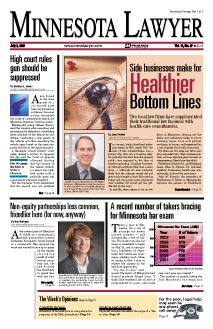
Considering that good faith on the part of insurance companies has been so much in the news lately, a recent opinion from U.S. District Court Judge James Rosenbaum merits a mention. In Babinski v. American Family Insurance Group, the judge refused the insurer’s attempt to limit its exposure to a fraction of the policy limits and socked it with a hefty attorney fee award of $35,712.33.
Donald Babinski’s son and daughter-in-law were killed in an auto accident when the son was driving Babinski’s truck. The daughter-in-law’s estate sued the son’s estate, of which Babinski was the personal representative. Donald Babinski had purchased $1 million in insurance coverage from American Family.
After sending a letter acknowledging the existence of liability coverage, American Family later argued that it had to pay only a maximum of $30,000 under a “household exclusion” or “drop-down exclusion.” Rosenbaum quickly disposed of the so-called household exclusion, whereby the policy arguably would not cover any person related to and residing in the household of the operator of the car, observing that Minnesota has held such exclusions invalid since 1979.
He also declined to enforce the drop-down exclusion, which would exclude coverage over the liability limits required by law, and mean the insurer was responsible for only 3 percent of the policy’s face value. Rosenbaum said the insurer used “stealth language” and the policy was vague, ambiguous, misleading and fell far below any ordinary consumer’s reasonable expectation. “This is a $1 million policy, and so it shall remain,” Rosenbaum ordered.
Showing posts with label insurance. Show all posts
Showing posts with label insurance. Show all posts
Tuesday, April 22, 2008


Monday, April 21, 2008
Pawlenty, lawmakers to insurers: You gotta' have (good) faith
Governor Tim Pawlenty last Friday signed into law the closely watched Good Faith bill. The new law puts insurers who fail to make a good-faith settlement offer when their liability is reasonably clear on the hook for up to $250K in damages and $100K in attorney fees. The caps were added as part of a legislative compromise. In political parlance, the new law has teeth, but not fangs.
Here’s an example of how the new law might work. You are sitting in traffic on a clear day, and an SUV rams into the rear of your car. The driver gets out, and says, “I’m so sorry, it’s completely my fault. I was sending a text message and drinking a cup of coffee.” The driver has $50K in coverage, and you have another $100K in underinsurance coverage. Your medical bills and related costs exceed your coverage, totalling $250K. The driver’s insurer pays you his full $50K policy limit. But your insurer, trying to save a few bucks, only offers you $75K in UIM limits. You go to trial, and, as predicted, the jury awards $250K.
Under the new good faith law, your insurer must pay you not only the full $100K limit of your UIM policy, but also an amount equal to half the amount your damages exceeded the amount offered by the insurer (i.e. $250K – $75K offer = $175K/ 2 = $87.5K). Thus, you are getting $87.5K more than you would have been entitled to receive under the policy because of the good-faith violation. In addition, you can recover up to another $100K in attorney fees.
With the caps, the amounts involved are not massive. But they are enough to change the math when the bean counters calculate whether or not it’s worthwhile to dicker with someone clearly entitled to benefits.
Here’s an example of how the new law might work. You are sitting in traffic on a clear day, and an SUV rams into the rear of your car. The driver gets out, and says, “I’m so sorry, it’s completely my fault. I was sending a text message and drinking a cup of coffee.” The driver has $50K in coverage, and you have another $100K in underinsurance coverage. Your medical bills and related costs exceed your coverage, totalling $250K. The driver’s insurer pays you his full $50K policy limit. But your insurer, trying to save a few bucks, only offers you $75K in UIM limits. You go to trial, and, as predicted, the jury awards $250K.
Under the new good faith law, your insurer must pay you not only the full $100K limit of your UIM policy, but also an amount equal to half the amount your damages exceeded the amount offered by the insurer (i.e. $250K – $75K offer = $175K/ 2 = $87.5K). Thus, you are getting $87.5K more than you would have been entitled to receive under the policy because of the good-faith violation. In addition, you can recover up to another $100K in attorney fees.
With the caps, the amounts involved are not massive. But they are enough to change the math when the bean counters calculate whether or not it’s worthwhile to dicker with someone clearly entitled to benefits.
Wednesday, August 22, 2007
Should homeowners be forced to carry flood insurance?
Few residents in the areas of southeastern Minnesota hit by flash floods last weekend had flood insurance on their homes. In the two hardest-hit counties -- Winona and Houston, total population 70,000 -- only 196 flood insurance policies have been issued for homes and businesses, according to the Federal Emergency Management Agency.
Insurance experts are predicting that many homeowners in the area who had homeowners insurance but not flood insurance will end up defaulting on their home loans. The cost will be absorbed by lenders, and the homeowners will have their credit ratings adversely affected by the defaults.
There are laws on the books that provide residents in especially flood-prone areas financial incentives to move away or elevate their homes. As the cost of rebuilding Minnesota’s flooded areas starts to mount, banks, mortgage lenders and insurers could start lobbying for compulsory flood insurance in areas such as southeastern Minnesota. Should homeowners in such areas, where floods are severe but rare, be legally compelled to own flood insurance?
Insurance experts are predicting that many homeowners in the area who had homeowners insurance but not flood insurance will end up defaulting on their home loans. The cost will be absorbed by lenders, and the homeowners will have their credit ratings adversely affected by the defaults.
There are laws on the books that provide residents in especially flood-prone areas financial incentives to move away or elevate their homes. As the cost of rebuilding Minnesota’s flooded areas starts to mount, banks, mortgage lenders and insurers could start lobbying for compulsory flood insurance in areas such as southeastern Minnesota. Should homeowners in such areas, where floods are severe but rare, be legally compelled to own flood insurance?
Thursday, June 14, 2007
Hatch has no problem with donning new hat
Former Attorney General Mike Hatch, speaking with Minnesota Lawyer earlier today, expressed no discomfort at leaving his role as consumer crusader to don the mantle of corporate champion.
In his new job as special counsel to Blackwell Burke in Minneapolis, Hatch will be practicing corporate law "with a tilt" toward health care, insurance and banking, he said. But, he also said, "my practice is what my clients tell me."
As for potential clients, Hatch has several irons in the fire. However, unlike when he was attorney general, now his clients want him to keep them out of the press.
In his new job as special counsel to Blackwell Burke in Minneapolis, Hatch will be practicing corporate law "with a tilt" toward health care, insurance and banking, he said. But, he also said, "my practice is what my clients tell me."
As for potential clients, Hatch has several irons in the fire. However, unlike when he was attorney general, now his clients want him to keep them out of the press.
Friday, May 4, 2007
Insurance bill a matter of faith
The Strib has an update on the good-faith insurance bill that allows direct actions against insurers and creates a cause of action against insurers who deny benefits without a reasonable basis.
Through an amazing act of legislative prestidigitation, the insurance bill was attached to a $2 billion public safety bill. Gov. Tim Pawlenty, who is against the insurance measure, threatened to veto the entire public safety bill unless the insurance rider was removed.
"During debate in the Senate and the House, supporters angrily accused Pawlenty and the insurance industry of refusing to compromise," the Strib reports. "The bill has been the target of extensive lobbying from the trial lawyers, who long have primarily supported DFLers, and of an expensive media campaign from the insurance industry, which has often supported Republicans."
The insurance provision was ultimately pulled to make way for the massive public-safety bill. (See "'Good faith' starts slugfest at Legislature.") It wil undoubtedly resurface again a separate piece of legislation.
The entire episode proves what I always have thought: "If laws are like sausages, stick with vegetarian option." In any event, as I posted before, I am sick of those lawyer-bashing insurance industry radio ads against this bill. If they really want to keep our rates down, why don't they stop running that obnoxious and deceptive ad campaign and send the money saved back to us in the form of a rebate or reduced premium?
Through an amazing act of legislative prestidigitation, the insurance bill was attached to a $2 billion public safety bill. Gov. Tim Pawlenty, who is against the insurance measure, threatened to veto the entire public safety bill unless the insurance rider was removed.
"During debate in the Senate and the House, supporters angrily accused Pawlenty and the insurance industry of refusing to compromise," the Strib reports. "The bill has been the target of extensive lobbying from the trial lawyers, who long have primarily supported DFLers, and of an expensive media campaign from the insurance industry, which has often supported Republicans."
The insurance provision was ultimately pulled to make way for the massive public-safety bill. (See "'Good faith' starts slugfest at Legislature.") It wil undoubtedly resurface again a separate piece of legislation.
The entire episode proves what I always have thought: "If laws are like sausages, stick with vegetarian option." In any event, as I posted before, I am sick of those lawyer-bashing insurance industry radio ads against this bill. If they really want to keep our rates down, why don't they stop running that obnoxious and deceptive ad campaign and send the money saved back to us in the form of a rebate or reduced premium?
Monday, April 30, 2007
Insurance lobby vs. trial lawyers
The Strib has a good article on its website about the dispute between the trial lawyers' and insurance lobby over a bill that would allow direct actions and bad-faith claims against insurers. (Bill pits lawyers against insurers.)
I should be annoyed at the Strib for doing it because we had something similar on the drawing board for today's paper, but wound up holding it over. However, the Strib did a good job and the info needs to get out there, so I will put a check on my editor's pride. We may still do something for the next issue, but our angle would be different.
BTW -- I don't know how many of you have heard those obnoxious insurance industry ads for this bill, but they are so bad that I changed the radio station on my alarm clock just to avoid waking up to them. They have taken the lowest road possible -- demonizing lawyers.
I should be annoyed at the Strib for doing it because we had something similar on the drawing board for today's paper, but wound up holding it over. However, the Strib did a good job and the info needs to get out there, so I will put a check on my editor's pride. We may still do something for the next issue, but our angle would be different.
BTW -- I don't know how many of you have heard those obnoxious insurance industry ads for this bill, but they are so bad that I changed the radio station on my alarm clock just to avoid waking up to them. They have taken the lowest road possible -- demonizing lawyers.
Subscribe to:
Posts (Atom)