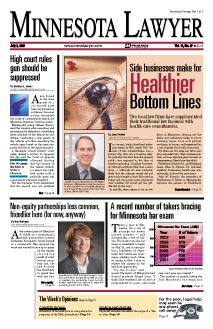
The Minnesota Lawyer website has posted its judicial election wrap up story. Click here to see it.
All-in-all the election went pretty smoothly. Unlike the primary, there were no recounts necessary -- which is probably for the best given that the Secretary of State's Office is pretty busy with that whole Coleman/Franken recount thing. It's an coincidence that there was no statewide recount necessary in Minnesota for 46 years -- and then within a couple of months of each other we get two, one in a judicial race, one is a Senate race.
Meanwhile, Minneapolis attorney (and former U.S. attorney) Tom Heffelfinger, who was to represent Coleman in the recount, has withdrawn.
"I am committed to a thorough, expeditious, and non-partisan review of the interaction between law enforcement and the community during the RNC. I have realized that taking a leadership role with Senator Coleman’s recount team would interfere with my commitment to the City and the RNC inquiry. Therefore I have informed the Coleman campaign I will not be available for the recount effort," Heffelfinger said in a press release issued today.
Thursday, November 6, 2008


Wednesday, November 5, 2008
How do Minnesota voters pick judges?
We at Minnesota Lawyer were interested in how members of the general public decide whom to cast their ballot for in judicial elections, so we sent intrepid associate editor Barbara Jones -- along with our one-man video crew -- on the road to find out. They stopped off at a polling place in downtown Minneapolis to talk with some voters. As you will find out from this video, judicial election choices can be like sausages, those who love them may not want to see how they are made ...
Incumbents sail through judicial races
The judicial election results were no surprise at the appellate level, with the incumbents winning handily in the two contested state Supreme Court races and one contested Court of Appeals races.
Minnesota Supreme Court Justice Paul Anderson skated by his challenger, 9th Judicial District magistrate Tim Tingelstad, by more than a 60/40 margin. A similar margin of victory was enjoyed by Court of Appeals Judge Terri Stoneburner, who turned back a challenge from International Falls attorney Dan Griffith, who was twice before unsuccessfully sought judicial office. (Tingelstad has also made two prior bids for judgeships.)
In the most closely watched appellate race, Supreme Court Justice Lorie Skjerven Gildea beat Hennepin County District Court Judge Deborah Hedlund by a 55/45 margin.
In the 2nd Judicial District (Ramsey County), Children's Law Center executive director Gail Chang Bohr pulled off what at least one political insider described as a "shocker" against former state lawmaker Howard Orenstein to fill a vacant judicial seat. Many had assumed Orenstein's name recognition in Ramsey County and knowledge of political campaigns would make him tough to beat. It bears pointing out that Bohr did narrowly miss beating Orienstein in a State Bar poll, and was endorsed by the Pioneer Press, so maybe it was not that much of a surprise. Nonetheless, it was quite an impressive feat for a political (errr... judicial) newcomer.
In the 4th judicial District (Hennepin County), former state lawmaker Jane Ranum prevailed over Hennepin County District Court referee David Piper in the most closely watched race. Ramum and Piper were competing for an open seat. Piper pumped $100,000 of his own money into his campaign war chest, but in the end lost by about 9 percent of the vote to the better-known ex-lawmaker.
In all the other District Court races, the incumbent prevailed. This includes another closely watched race in the 4th Judicial District, where Judge James Swenson turned back a challenge from Thomas Haeg, a former magistrate with the court.
Click here to see the complete breakdown from the Secretary of State's website.
Minnesota Supreme Court Justice Paul Anderson skated by his challenger, 9th Judicial District magistrate Tim Tingelstad, by more than a 60/40 margin. A similar margin of victory was enjoyed by Court of Appeals Judge Terri Stoneburner, who turned back a challenge from International Falls attorney Dan Griffith, who was twice before unsuccessfully sought judicial office. (Tingelstad has also made two prior bids for judgeships.)
In the most closely watched appellate race, Supreme Court Justice Lorie Skjerven Gildea beat Hennepin County District Court Judge Deborah Hedlund by a 55/45 margin.
In the 2nd Judicial District (Ramsey County), Children's Law Center executive director Gail Chang Bohr pulled off what at least one political insider described as a "shocker" against former state lawmaker Howard Orenstein to fill a vacant judicial seat. Many had assumed Orenstein's name recognition in Ramsey County and knowledge of political campaigns would make him tough to beat. It bears pointing out that Bohr did narrowly miss beating Orienstein in a State Bar poll, and was endorsed by the Pioneer Press, so maybe it was not that much of a surprise. Nonetheless, it was quite an impressive feat for a political (errr... judicial) newcomer.
In the 4th judicial District (Hennepin County), former state lawmaker Jane Ranum prevailed over Hennepin County District Court referee David Piper in the most closely watched race. Ramum and Piper were competing for an open seat. Piper pumped $100,000 of his own money into his campaign war chest, but in the end lost by about 9 percent of the vote to the better-known ex-lawmaker.
In all the other District Court races, the incumbent prevailed. This includes another closely watched race in the 4th Judicial District, where Judge James Swenson turned back a challenge from Thomas Haeg, a former magistrate with the court.
Click here to see the complete breakdown from the Secretary of State's website.
An up-close look at democracy in action
I spent yesterday (and I mean the whole day -- 5:30 a.m. to 9:00 p.m.) working as a Ramsey County election judge, and it was an eye-opening experience.
The precinct where I worked wasn’t even one of the busiest in town, attracting about 1,100 voters during the 13 hours the polls were open. But there was a long line to start the day, and voters came in steady streams throughout.
The evidence that Minnesota saw near-record voter turnout was confirmed by the hundreds of first-time and newly-registered voters, and the willingness of people to go the extra mile to make sure others got a chance to cast a ballot. On a regular basis, registered voters from the neighborhood -- including folks from the precinct’s halfway houses and homeless shelters -- returned to the polls with friends, roommates and neighbors who wanted to vote, too. (Under Minnesota law, a registered voter can “vouch” for the residency of anyone who lives in the same precinct, even if that person doesn’t have a permanent address.)
Even though no TVs or radios were allowed inside the polling place, the stream of new and young voters gave me a strong hunch about how the presidential race would turn out. That hunch was confirmed when, after closing, the precinct’s chief election judge ran the final tally and found that almost 900 voters (more than 80 percent) of voters in this mostly white, overwhelmingly working-class precinct voted for Barack Obama.
The enthusiasm of the voters even carried over into the judicial elections. Many voters who were advised to examine both sides of the ballot were glad to discover they would have a say in who their judges would be, and a few even brought notes into the voting booth based on research they had done on the judicial candidates.
The precinct where I worked wasn’t even one of the busiest in town, attracting about 1,100 voters during the 13 hours the polls were open. But there was a long line to start the day, and voters came in steady streams throughout.
The evidence that Minnesota saw near-record voter turnout was confirmed by the hundreds of first-time and newly-registered voters, and the willingness of people to go the extra mile to make sure others got a chance to cast a ballot. On a regular basis, registered voters from the neighborhood -- including folks from the precinct’s halfway houses and homeless shelters -- returned to the polls with friends, roommates and neighbors who wanted to vote, too. (Under Minnesota law, a registered voter can “vouch” for the residency of anyone who lives in the same precinct, even if that person doesn’t have a permanent address.)
Even though no TVs or radios were allowed inside the polling place, the stream of new and young voters gave me a strong hunch about how the presidential race would turn out. That hunch was confirmed when, after closing, the precinct’s chief election judge ran the final tally and found that almost 900 voters (more than 80 percent) of voters in this mostly white, overwhelmingly working-class precinct voted for Barack Obama.
The enthusiasm of the voters even carried over into the judicial elections. Many voters who were advised to examine both sides of the ballot were glad to discover they would have a say in who their judges would be, and a few even brought notes into the voting booth based on research they had done on the judicial candidates.
Tuesday, November 4, 2008
Updates on judicial election results
The Judicial Election results -- updated as they come in -- are available on the Secretary of State's website.
Click here to view.
Voting early but not often
I haven’t been this excited to vote since the first time I cast a ballot, and considering that was for Abraham Lincoln, that’s saying something. It was really fun this morning to be part of the crowd and watch our process. It was a beautiful golden morning and actually a pleasure to stand in line. I got to the polling place about 7:20 and I was about the 250th voter when I got in around 8:00. I live in a precinct near a university so my demographics are skewed, but the vast majority of the group was under 30. That was very cool. A number of people brought their children with them, which I haven’t noticed before, and which was also very cool. However, I thought the woman with three very active little girls who asked the election judges if they had any toys for them was a little odd. Did she think she wasn’t going to have to stand in line? Ditto for the woman with the (non-service) dog. I’m kind of nervous around dogs, even when they are leashed, and I didn’t think the canine needed a civics lesson. But that’s just me. On the other hand, the dog wasn’t questioning anybody’s patriotism.
Monday, November 3, 2008
A brief message from the editor
Thank you to the thousands of dedicated voters who found and used Minnesota Lawyer's online judicial election guide, our website and this blog to get information about the 2008 judicial election. I was heartened to see how many folks out there want to cast a meaningful ballot in the judicial races and availed themselves of the information that we provided. A number of you were kind enough to drop me e-mails and calls to express your gratitude at having this information at your fingertips, to which I can only reply the pleasure was ours.
If I can be allowed the indulgence of making a few thank yous of my own, I would like to recognize the efforts of the judicial candidates for participating; the rest of our editorial staff (particularly our Web editor, Adam Johnson); Bill Klotz, our photographer/ videographer; the IT folks who made this possible; and our publisher, Steve Jahn, and our corporate parent, Dolan Media, for believing this voter-information project was important enough to allow us to dedicate substantial time and resources to it.
This post concludes Minnesota Lawyer's pre-election coverage of the 2008 judicial races. We will, of course, have follow up coverage of the judicial election on our website and in the print edition of Minnesota Lawyer newspaper.
I would also like to take this opportunity to announce that very soon we will be launching a completely revamped version of the Minnesota Lawyer blog with an exciting new look. Stay tuned for details. Thanks again for visiting, and we hope to see you again soon!
-- Mark A. Cohen
Editor-in-chief, Minnesota Lawyer
P.S. Don't forget to vote tomorrow! Click here for more info on the judicial races if you are still doing your research.
If I can be allowed the indulgence of making a few thank yous of my own, I would like to recognize the efforts of the judicial candidates for participating; the rest of our editorial staff (particularly our Web editor, Adam Johnson); Bill Klotz, our photographer/ videographer; the IT folks who made this possible; and our publisher, Steve Jahn, and our corporate parent, Dolan Media, for believing this voter-information project was important enough to allow us to dedicate substantial time and resources to it.
This post concludes Minnesota Lawyer's pre-election coverage of the 2008 judicial races. We will, of course, have follow up coverage of the judicial election on our website and in the print edition of Minnesota Lawyer newspaper.
I would also like to take this opportunity to announce that very soon we will be launching a completely revamped version of the Minnesota Lawyer blog with an exciting new look. Stay tuned for details. Thanks again for visiting, and we hope to see you again soon!
-- Mark A. Cohen
Editor-in-chief, Minnesota Lawyer
P.S. Don't forget to vote tomorrow! Click here for more info on the judicial races if you are still doing your research.
Hennepin, Ramsey District Court races poised to be most expensive
The front runner for the honor of the most expensive judicial race this year goes to the contest between David Piper and Jane Ranum for an open seat on the Hennepin County District Court. So far, $203,728 has been raised for that race. Most of the money has been raised by Piper, whose $168,760 in contributions includes the $100,000 which he has loaned to his own campaign.
A close second is the race between Gail Chang Bohr and Howard Orenstein for the open Ramsey County seat. So far, a combined $158,730 has been raised by those candidates.
At the statewide level, Minnesota Supreme Court Justices Lorie Gildea and Paul Anderson have done comparatively well individually in attracting contributions, garnering $64,070 and $58,278, respectively. Meanwhile, their opponents, Judge Deborah Hedlund and Tim Tingelstad, have collected only about $28,000 combined.
At the other end of the spectrum is Alan Eugene Link, who has challenged Hennepin County District Court Judge Philip Bush. Link -- who has declined to provide any information about his campaign to Minnesota Lawyer and other media outlets and who has not participated in any public candidate forums -- reports self-financing his $536 campaign. He reportedly spent $300 on his filing fee and $236.76 on "door hangers," which can't have gone far in the state's most populous county. To my knowledge, this stealth candidate has made no public appearances during his entire campaign. Bush has raised $16,977 to defeat the missing Link. (Some have speculated that Link is hoping that voters somehow equate his opponent's name with that of our not-so-popular president. There is, by the way, no relation.)
More information about the candidates' funding is available at the Campaign Finance and Public Disclosure Board website.
A close second is the race between Gail Chang Bohr and Howard Orenstein for the open Ramsey County seat. So far, a combined $158,730 has been raised by those candidates.
At the statewide level, Minnesota Supreme Court Justices Lorie Gildea and Paul Anderson have done comparatively well individually in attracting contributions, garnering $64,070 and $58,278, respectively. Meanwhile, their opponents, Judge Deborah Hedlund and Tim Tingelstad, have collected only about $28,000 combined.
At the other end of the spectrum is Alan Eugene Link, who has challenged Hennepin County District Court Judge Philip Bush. Link -- who has declined to provide any information about his campaign to Minnesota Lawyer and other media outlets and who has not participated in any public candidate forums -- reports self-financing his $536 campaign. He reportedly spent $300 on his filing fee and $236.76 on "door hangers," which can't have gone far in the state's most populous county. To my knowledge, this stealth candidate has made no public appearances during his entire campaign. Bush has raised $16,977 to defeat the missing Link. (Some have speculated that Link is hoping that voters somehow equate his opponent's name with that of our not-so-popular president. There is, by the way, no relation.)
More information about the candidates' funding is available at the Campaign Finance and Public Disclosure Board website.
The statewide judicial races: An analysis
Minnesota Lawyer doesn’t offer endorsements of judges, so the comments below are strictly my own as someone who has closely followed these races.
Justice Paul Anderson is the second most senior justice on the high court, and was previously the chief judge of the Minnesota Court of Appeals. He takes a scholarly approach to the law, and is the court’s resident historian. He has spearheaded the court’s public outreach efforts and has become its unofficial “goodwill ambassador.” Tim Tingelstad is a magistrate in the 9th Judicial District whose campaign emphasizes his “biblical worldview,” but does not make the case that his qualifications are superior to Anderson’s. (Tingelstad has said that he would decide cases on the facts and law rather than on his religious views, although most of his website, www.highesthill.com, seems to be dedicated to the latter.) Tingelstad strikes me as a sincere individual, but has nowhere near the breadth of experience and support that Anderson has. Anderson is the clear choice here.
Justice Paul Anderson is the second most senior justice on the high court, and was previously the chief judge of the Minnesota Court of Appeals. He takes a scholarly approach to the law, and is the court’s resident historian. He has spearheaded the court’s public outreach efforts and has become its unofficial “goodwill ambassador.” Tim Tingelstad is a magistrate in the 9th Judicial District whose campaign emphasizes his “biblical worldview,” but does not make the case that his qualifications are superior to Anderson’s. (Tingelstad has said that he would decide cases on the facts and law rather than on his religious views, although most of his website, www.highesthill.com, seems to be dedicated to the latter.) Tingelstad strikes me as a sincere individual, but has nowhere near the breadth of experience and support that Anderson has. Anderson is the clear choice here.
Justice Lorie Skjerven Gildea vs. Judge Deborah Hedlund
It’s highly unusual for a sitting trial court judge to challenge a sitting Supreme Court justice, which is why this race has generated a lot of interest. Gov. Tim Pawlenty appointed Justice Lorie Skjerven Gildea just about three years ago after she served a brief stint in the District Court. She has experience as a prosecutor and as an attorney in private practice. Her challenger, Deborah Hedlund, has been a Hennepin County District Court judge for 28 years. Hedlund has made as a center point of her campaign the idea of adding someone with extensive experience on the trial court bench on the Supreme Court. (Gildea, who was on the Hennepin bench for a few months, is the only justice on the seven-justice court who served as a trial judge.) Hedlund also stresses her criminal trial experience. Gildea, on the other hand, counters she has worked on the high court for three years and has “done well.” Indeed, the Minnesota Supreme Court has an excellent reputation and is fairly collegial. Gildea’s transition onto the court did not change that. While I think Hedlund makes a good point that a seasoned trial court judge could add something to the court, I don’t think she’s made the case that that person should be her or that she would make a better justice than Gildea, who is already on the court and has garnered the support of more than 115 appellate attorneys and the majority of State Bar members polled. While this is a closer call than the Anderson/ Tingelstad matchup, I think Gildea is the better choice. (I make this conclusion without regard to the recent curious e-mail dustup involving Hedlund since it is unclear what was actually going on there.)
Terri Stoneburner vs. Dan Griffith
Terri Stoneburner spent 10 years as a trial court judge before Gov. Jesse Ventura elevated her to the Court of Appeals eight years ago. She was in private practice for 10 years prior to that. I think that this is the perfect background for a seat on the Court of Appeals, which has as its primary job reviewing trial court cases to determine if an error has been made. Her opponent, Dan Griffith, who is running for a judgeship for the third time, is an attorney in private practice in International Falls. He has emphasized his belief in contested judicial elections as his reason for running rather than making the case he would make a better appellate judge than Stoneburner. I think Stoneburner is the clear choice here.
Information on Minnesota's judicial races
Don't forget to check out Minnesota Lawyer's online Judicial election guide to get information on the judicial races. Click here to visit.
And don't forget to vote tomorrow!
And don't forget to vote tomorrow!
Sunday, November 2, 2008
Video clip: Howard Orenstein
Hennepin County prosecutor Howard Orenstein is running against Children's Law Center of Minnesota executive director Gail Chang Bohr for an open seat on the Ramsey County bench. The following clip is from a debate between the two candidates at Hamline University School of Law on Oct. 29, 2008.
To view the YouTube version, click here.
To view the YouTube version, click here.
Video clip: Gail Chang Bohr
Children's Law Center of Minnesota executive director Gail Chang Bohr is running against Hennepin County prosecutor Howard Orenstein for an open seat on the Ramsey County bench. The following clip is from a debate between the two candidates at Hamline University School of Law on Oct. 29, 2008.
For the YouTube version, click here.
For the YouTube version, click here.
Subscribe to:
Posts (Atom)