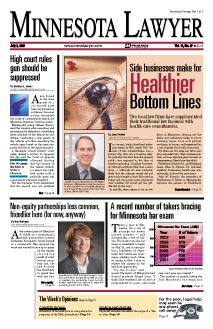
The big news from state Legislative Auditor Jim Nobles about his preliminary investigation of the Minnesota Attorney General’s office is…that there is no news.
Nobles, you might recall, is looking into allegations of ethical and legal lapses in Attorney General Lori Swanson's office for the purpose deciding if a full-scale probe is warranted.
Swanson and some of her deputies have been accused of pressuring lawyers to give bad advice to state agency clients and to find defendants to fit lawsuits on high-profile topics.
Nobles yesterday sent a memo to the Legislative Audit Commission saying that the preliminary assessment is in process, but didn’t have any more findings to report.
"This is a particularly demanding time for [the auditor's office] since we are in the process of launching six new evaluations and completing work on a number of other audits and investigations," Nobles wrote. "When our preliminary assessment has been completed, I will communicate to you in writing both the results of our assessment, as well as our decision concerning any additional action."
“The decision of whether to go forward with a more expanded investigation is probably several weeks away,” Nobles told Minnesota Lawyer.
Friday, April 18, 2008


Awards to be presented at AILA regional conference
 Two important awards will be presented at the Upper Midwest Immigration Conference taking place in Eagan on May 1 and 2.
The Immigrant of Distinction Award, which honors a local immigrant who has significantly impacted her community and profession, will be bestowed upon Ms. Melissa Nambangi (pictured at right). Nambangi is co-founder and executive director of the Minnesota African Women’s Association and is an advocate and speaker on African women’s and immigrant issues relating to sexual assault, domestic violence and basic human rights.
In addition, a Lifetime Achievement Award will be presented to Nobel prize winner professor Leonid Hurwicz. Hurwicz is Regent’s Professor of Economics (Emeritus) at the University of Minnesota and was one of three recipients of the 2007 Nobel Prize in Economic Sciences for work on mechanism design.
The two-day regional conference is being sponsored by the Minnesota/Dakotas chapter of the American Immigration Lawyers Association and the Advocates for Human Rights. Organizers have planned seminars on a wide variety of topics -- including I-9 compliance, ICE enforcement issues, conflicts of interests, corporate immigration policies and criminal liability for employers and workers -- in the hopes of attracting more than just immigration lawyers.
For an overview of AILA and the upcoming conference, see “Immigration lawyers’ group seeks to educate and advocate” in the March 17 issue of Minnesota Lawyer.
Thursday, April 17, 2008
Report from Washington, D.C.: MSBA lobbies for Legal Aid

Minnesota Lawyer associate editor Barbara Jones, reporting from our nation’s capital, said that the Minnesota State Bar Association delegation participating in the American Bar Association’s Lobby Day had a productive initial round of meetings with Minnesota members of Congress and their representatives.
The MSBA group includes MSBA president Brian Melendez, Minneapolis attorney Sue Holden (past president of the MSBA), Hennepin County District Court Judge Cara Lee Neville, St. Cloud attorney Michael Ford (MSBA president-elect), MSBA staff member Nancy Mischel and Jerry Lane of Mid-Minnesota Legal Assistance.
A big part of the lobbying activity has been in support of more federal money for Legal Aid. Nationally, the ABA has called upon Congress to raise Legal Aid funding by $121 million to a total of $471 million. Barbara reports that Minnesota Congress members have so far been generally been very supportive of Legal Aid in the delegation’s meetings with them.
The delegation yesterday met with Congressmen Keith Ellison and Tim Walz. It also met with representatives from the offices of Senator Norm Coleman and Congressman Jim Ramstad. (The ABA recognized Ramstad for his contributions to the justice system at an event last night.)
Barb reports that Walz told the group that equal access to justice is of “paramount concern," and said he will do whatever needs to be done to get legislation through that helps to ensure it.
An interesting side note: Barb reports that Melendez is only meeting with the DFL members of the Minnesota delegation. Melendez, of course, in addition to being MSBA president, is chair of the state’s DFL Party.
The MSBA group includes MSBA president Brian Melendez, Minneapolis attorney Sue Holden (past president of the MSBA), Hennepin County District Court Judge Cara Lee Neville, St. Cloud attorney Michael Ford (MSBA president-elect), MSBA staff member Nancy Mischel and Jerry Lane of Mid-Minnesota Legal Assistance.
A big part of the lobbying activity has been in support of more federal money for Legal Aid. Nationally, the ABA has called upon Congress to raise Legal Aid funding by $121 million to a total of $471 million. Barbara reports that Minnesota Congress members have so far been generally been very supportive of Legal Aid in the delegation’s meetings with them.
The delegation yesterday met with Congressmen Keith Ellison and Tim Walz. It also met with representatives from the offices of Senator Norm Coleman and Congressman Jim Ramstad. (The ABA recognized Ramstad for his contributions to the justice system at an event last night.)
Barb reports that Walz told the group that equal access to justice is of “paramount concern," and said he will do whatever needs to be done to get legislation through that helps to ensure it.
An interesting side note: Barb reports that Melendez is only meeting with the DFL members of the Minnesota delegation. Melendez, of course, in addition to being MSBA president, is chair of the state’s DFL Party.
Twin Cities PI firm launches clever (gasp) TV ads
 The folks at Sieben, Grose, Von Holtum & Carey recently launched a new ad campaign that I predict will become a watershed moment in Twin Cities law firm marketing.
The two TV commercials, coined "We've Seen It All," are fun, clever and far more amusing than most personal injury ads out there. And this is exactly the sort of thing we here at Minnesota Lawyer have been harping about for years: law firms need to embrace video.
 They also had the foresight to post their videos on YouTube. Now, I don't expect views to reach the viral fame of E*Trade baby, but it's a start.
And if I ever encounter a UFO or banana while behind the wheel, I know who I'm calling!
A well-reasoned decision decided on reasonable doubt
We recently referenced Hennepin County District Court Judge Kevin Burke's decision in State v. King on this blog. The case is the subject of the editor's column in Minnesota Lawyer. We are making it available now to our blog readers as a special blog extra.
Update April 17, 2008; 11:00 p.m.:
Press reports after the below column went to press have made an issue of the fact that Burke's own dogs have been the subject of some past complaints. (Burke also has a young 3-year-old child at home.) My initial thought is the fact that Burke may or may not have rambunctious dogs (or for that matter may or may not have a rambunctious child) is really not that much of an issue. But I will, of course be closely monitoring any further developments.
By Mark A. Cohen
In these days of nonstop political pressure to circumscribe judicial authority with mandatory sentences and similar discretion-limiting devices, I can think of no better poster-child case for letting trial court judges do what we pay them to do than Judge Kevin Burke’s eloquent opinion in State v. King.
The Hennepin County decision was issued on April 11 in a much-publicized prosecution of a Zachary King, who was charged with second-degree manslaughter after his child, Zach Jr., was killed by a family pet.
Zach Jr. was one of four young children in the house who shared quarters with two full-grown pit bulls and five pit bull puppies. Before the fatal attack, the pit bull involved, named “Face,” had been involved in three biting incidents, including one with Zach Jr. However, the dog was never declared a dangerous animal and the child’s parents were not told to destroy it.
The state decided to prosecute King for the death of his child. Specifically, the state contended that King was guilty of violating a state law that makes it a crime for someone to cause the death of another by negligently failing to keep properly confined any animal the person knows has vicious propensities.
The entire case wound up bubbling down to whether the prior bites put King on notice that Face had vicious propensities.
“What happened in this case was a horrific tragedy,” Burke’s meticulously crafted opinion begins. “Although the statute with which Mr. King was charged with violating has rarely been used, it is understandable why the Hennepin County Attorney’s Office decided to prosecute Mr. King. When a tragedy like this occurs, all of us want to find a person and hold them accountable. With hindsight people never mistakes. With hindsight Mr. King and his wife painfully understand that having four young children, two pit bulls and five pit bull puppies simply makes no sense.”
Burke goes on to recite the facts, some of which favor King, others of which favor the state. The judge paints a portrait of a loving family dealing with a tragic set of circumstances. He compliments the prosecutors on a well-done and professional job in presenting the state’s case.
Burke notes that Dr. Petra Mertens, a well-regarded veterinarian with expertise in dog psychology, testified that no child between the ages of 7 and 12 should be left alone with a dog because every dog has the potential to bite children. This is especially true with young boys, the doctor reportedly said.
“Dr. Mertens’ advice is wise,” writes Burke. “After Zach Jr.’s death, Hennepin County Child Protection, Mr. King, [his attorney, Craig Cascarano], and the Hennepin County Attorney’s Office all sought Dr. Mertens’ advice. Unfortunately all of that occurred too late. Zach Jr. was dead.”
After weighing all the evidence, Burke decided the case on the basis of reasonable doubt, concluding that the state had not met that high standard.
“Given what happened in this case there is no victor,” Burke writes. “A child is dead, his siblings and parents are traumatized, and a lot of people who never knew these people are bewildered and wonder how can this happen?” Who is responsible?”
Those are haunting questions indeed. None of the medical professionals who treated the pit bull bites thought to tell the family to destroy the dog. The insurance company that paid out a bite claim also made no such recommendation and did not raise rates to such an extent to get the family’s attention. The city of Minneapolis never followed up and went through the process of having the dog declared dangerous.
Do we blame all of them? Some of them? None of them? It’s difficult to say.
These are the kinds of cases that can really make you toss and turn at night. Most of us know we won’t commit some sort of horrific intentional crime, but it is altogether too easy for some thoughtless bit of negligence to turn tragic. We make mistakes all the time, and usually the consequences are light. What a nightmare it must be when those mistakes lead to horrific results. I think about that every time I hear about a busy parent who forgets his or her baby is strapped into the rear car seat on a hot July day.
I feel a little better to know there are judges like Burke on the bench who will take a thoughtful approach to such cases. There will be times when criminal punishment is warranted for mistakes, and times when it isn’t. I accept Burke’s verdict that this particular case falls into the latter category. But, despite the favorable result for the defense, I have to agree with the judge’s observation that this is a case without a winner.
Update April 17, 2008; 11:00 p.m.:
Press reports after the below column went to press have made an issue of the fact that Burke's own dogs have been the subject of some past complaints. (Burke also has a young 3-year-old child at home.) My initial thought is the fact that Burke may or may not have rambunctious dogs (or for that matter may or may not have a rambunctious child) is really not that much of an issue. But I will, of course be closely monitoring any further developments.
Burke’s opinion in ‘State v. King’ worth reading
By Mark A. Cohen
In these days of nonstop political pressure to circumscribe judicial authority with mandatory sentences and similar discretion-limiting devices, I can think of no better poster-child case for letting trial court judges do what we pay them to do than Judge Kevin Burke’s eloquent opinion in State v. King.
The Hennepin County decision was issued on April 11 in a much-publicized prosecution of a Zachary King, who was charged with second-degree manslaughter after his child, Zach Jr., was killed by a family pet.
Zach Jr. was one of four young children in the house who shared quarters with two full-grown pit bulls and five pit bull puppies. Before the fatal attack, the pit bull involved, named “Face,” had been involved in three biting incidents, including one with Zach Jr. However, the dog was never declared a dangerous animal and the child’s parents were not told to destroy it.
The state decided to prosecute King for the death of his child. Specifically, the state contended that King was guilty of violating a state law that makes it a crime for someone to cause the death of another by negligently failing to keep properly confined any animal the person knows has vicious propensities.
The entire case wound up bubbling down to whether the prior bites put King on notice that Face had vicious propensities.
“What happened in this case was a horrific tragedy,” Burke’s meticulously crafted opinion begins. “Although the statute with which Mr. King was charged with violating has rarely been used, it is understandable why the Hennepin County Attorney’s Office decided to prosecute Mr. King. When a tragedy like this occurs, all of us want to find a person and hold them accountable. With hindsight people never mistakes. With hindsight Mr. King and his wife painfully understand that having four young children, two pit bulls and five pit bull puppies simply makes no sense.”
Burke goes on to recite the facts, some of which favor King, others of which favor the state. The judge paints a portrait of a loving family dealing with a tragic set of circumstances. He compliments the prosecutors on a well-done and professional job in presenting the state’s case.
Burke notes that Dr. Petra Mertens, a well-regarded veterinarian with expertise in dog psychology, testified that no child between the ages of 7 and 12 should be left alone with a dog because every dog has the potential to bite children. This is especially true with young boys, the doctor reportedly said.
“Dr. Mertens’ advice is wise,” writes Burke. “After Zach Jr.’s death, Hennepin County Child Protection, Mr. King, [his attorney, Craig Cascarano], and the Hennepin County Attorney’s Office all sought Dr. Mertens’ advice. Unfortunately all of that occurred too late. Zach Jr. was dead.”
After weighing all the evidence, Burke decided the case on the basis of reasonable doubt, concluding that the state had not met that high standard.
“Given what happened in this case there is no victor,” Burke writes. “A child is dead, his siblings and parents are traumatized, and a lot of people who never knew these people are bewildered and wonder how can this happen?” Who is responsible?”
Those are haunting questions indeed. None of the medical professionals who treated the pit bull bites thought to tell the family to destroy the dog. The insurance company that paid out a bite claim also made no such recommendation and did not raise rates to such an extent to get the family’s attention. The city of Minneapolis never followed up and went through the process of having the dog declared dangerous.
Do we blame all of them? Some of them? None of them? It’s difficult to say.
These are the kinds of cases that can really make you toss and turn at night. Most of us know we won’t commit some sort of horrific intentional crime, but it is altogether too easy for some thoughtless bit of negligence to turn tragic. We make mistakes all the time, and usually the consequences are light. What a nightmare it must be when those mistakes lead to horrific results. I think about that every time I hear about a busy parent who forgets his or her baby is strapped into the rear car seat on a hot July day.
I feel a little better to know there are judges like Burke on the bench who will take a thoughtful approach to such cases. There will be times when criminal punishment is warranted for mistakes, and times when it isn’t. I accept Burke’s verdict that this particular case falls into the latter category. But, despite the favorable result for the defense, I have to agree with the judge’s observation that this is a case without a winner.
Wednesday, April 16, 2008
Courts in surrounding states continue to smile for the cameras
It’s good enough for Wisconsin, Iowa, and South Dakota. But not for Minnesota.
Our neighbors to the west are actually not the latest state to allow cameras and other recording devices into its Supreme Court -- it did so in 2001. But now, thanks to a high court ruling, South Dakota has expanded the use of recording devices, allowing cameras and tape recorders in its circuit courts. Next up in SoDak: A study of whether cameras should be allowed in lower courts.
Meanwhile, as has been reported in Minnesota Lawyer, the issue of cameras in our courtrooms is a dead discussion for the time being, despite endorsements of the practice from judges in both Iowa and Wisconsin.
Do we know something that all the states around us don’t know? Or is it the other way around?
Our neighbors to the west are actually not the latest state to allow cameras and other recording devices into its Supreme Court -- it did so in 2001. But now, thanks to a high court ruling, South Dakota has expanded the use of recording devices, allowing cameras and tape recorders in its circuit courts. Next up in SoDak: A study of whether cameras should be allowed in lower courts.
Meanwhile, as has been reported in Minnesota Lawyer, the issue of cameras in our courtrooms is a dead discussion for the time being, despite endorsements of the practice from judges in both Iowa and Wisconsin.
Do we know something that all the states around us don’t know? Or is it the other way around?
Tuesday, April 15, 2008
Judicial elections: Find out how the Midwest was won!

How many chances do you get to go to a CLE where two attorney presenters are debating judicial elections while wearing circa 1858 period costumes?
Not many, I’ll wager. So hang on to your (cowboy) hat and get ready to saddle up next week for a one-hour CLE presentation featuring a re-enactment of key portions of the pre-statehood judicial-election debate -- with dialogue drawn directly from actual constitutional-convention transcripts. The lawyer/actors presenting the debate are Cambridge attorney Mark Benjamin (lately known for helping some bars to burn a hole in the smoking ban using the “theatrical performance” exception) and assistant Attorney General J.P. Barone, who is involved in community theatre with the Lakeshore Players Theatre in White Bear Lake. The two lawyers are being billed as the “Sesquicentennial Players” -- which is a great name, but, unfortunately, one that they will have to wait another 150 years to reuse.
The event also features Minnesota Women Lawyers Voter Outreach Committee Co-Chair Karen Cole and Hamline University School of Law Professor Mary Jane Morrison, who will put things into context with a discussion of Minnesota’s constitutional conventions and how they gave rise to the judicial elections provision of the Minnesota Constitution. Karen promises me that the commentary will be witty and the analysis insightful (or was it the other way around?). In any case, knowing Karen, they’ll deliver.
The program -- entitled “Judicial Elections in and the Minnesota Constitution: Past, Present and Future” -- will be held at the Halleland Lewis law office in Minneapolis on Tuesday, April 22 from 5:30-6:30 p.m.
To register, contact gwinther@mwlawyers.org or register online by clicking here. (The registration fee is $10 per attendee. Paper money, credit or circa 1858 gold pieces are all presumably acceptable …)
Not many, I’ll wager. So hang on to your (cowboy) hat and get ready to saddle up next week for a one-hour CLE presentation featuring a re-enactment of key portions of the pre-statehood judicial-election debate -- with dialogue drawn directly from actual constitutional-convention transcripts. The lawyer/actors presenting the debate are Cambridge attorney Mark Benjamin (lately known for helping some bars to burn a hole in the smoking ban using the “theatrical performance” exception) and assistant Attorney General J.P. Barone, who is involved in community theatre with the Lakeshore Players Theatre in White Bear Lake. The two lawyers are being billed as the “Sesquicentennial Players” -- which is a great name, but, unfortunately, one that they will have to wait another 150 years to reuse.
The event also features Minnesota Women Lawyers Voter Outreach Committee Co-Chair Karen Cole and Hamline University School of Law Professor Mary Jane Morrison, who will put things into context with a discussion of Minnesota’s constitutional conventions and how they gave rise to the judicial elections provision of the Minnesota Constitution. Karen promises me that the commentary will be witty and the analysis insightful (or was it the other way around?). In any case, knowing Karen, they’ll deliver.
The program -- entitled “Judicial Elections in and the Minnesota Constitution: Past, Present and Future” -- will be held at the Halleland Lewis law office in Minneapolis on Tuesday, April 22 from 5:30-6:30 p.m.
To register, contact gwinther@mwlawyers.org or register online by clicking here. (The registration fee is $10 per attendee. Paper money, credit or circa 1858 gold pieces are all presumably acceptable …)
Monday, April 14, 2008
An MSBA delegation is off to Washington, D.C., this week

This week intrepid Minnesota Lawyer associate editor Barbara Jones is accompanying a delegation from the Minnesota State Bar Association to Washington, D.C. The MSBA group plans to meet with members of Congress from Minnesota to discuss issues of interest to the bar as part of American Bar Association Day. Barbara has promised to transmit back a couple of blog items to let us know what the MSBA delegation is up to, so stay tuned.
Avoiding homeowners' liability isn't child's play ...
Minnesota Lawyer has an interesting lead story this week (doesn't it always?) sprouting from a Court of Appeals case that discusses the duty you owe a child visitor in your home. Are you liable when little Junior comes over with his mom or dad, tips over your Ming vase and cuts himself on one of the pieces?
Probably not. This scenario is not altogether different than what occurred in Foss v. Kincade, et al. That case involved a 3-year-old boy who, while visiting the homeowner's house with his mother, was injured when he tipped over a bookcase. (The Minnesota Lawyer story, written by Michelle Lore, is "Injured child’s lawsuit against homeowner dismissed.") Two key facts in the case were that the mother was present to supervise the child, and the plaintiff in the case (the child's father) admitted that the danger the bookcase posed was obvious.
But what if the facts had been different? What if the mother had not been there? What if the homeowner had been acting as a babysitter? What if the homeowner was being paid for doing the babysitting? What if the homeowner's daughter was being paid to doing the babysitting? What if the danger had not been so obvious?
Despite the favorable result in this case, if you have no kids but expect child visitors upon occassion, you may want to switch from wine glasses to sippy cups ...
Probably not. This scenario is not altogether different than what occurred in Foss v. Kincade, et al. That case involved a 3-year-old boy who, while visiting the homeowner's house with his mother, was injured when he tipped over a bookcase. (The Minnesota Lawyer story, written by Michelle Lore, is "Injured child’s lawsuit against homeowner dismissed.") Two key facts in the case were that the mother was present to supervise the child, and the plaintiff in the case (the child's father) admitted that the danger the bookcase posed was obvious.
But what if the facts had been different? What if the mother had not been there? What if the homeowner had been acting as a babysitter? What if the homeowner was being paid for doing the babysitting? What if the homeowner's daughter was being paid to doing the babysitting? What if the danger had not been so obvious?
Despite the favorable result in this case, if you have no kids but expect child visitors upon occassion, you may want to switch from wine glasses to sippy cups ...
Friday, April 11, 2008
Dad acquitted in son's death from dog bite.
Zachary Zane King was acquitted today of second degree manslaughter in the death of his son, Zach Jr., who was bitten by the family pit bull. The verdict by Judge Kevin Burke is available here. Burke said that there was no evidence to prove beyond a reasonable doubt that King knew that the dog was dangerous, as required by the statute under which he was charged.
ABA section launches consumer credit website

The American Bar Association Section of Business Law has launched safeborrowing.com -- a website designed to inform consumers about credit issues and increase financial literacy.
The site’s homepage has an eye-catching slogan: “Welcome to the place to stop before you shop.” Safeborrowing.com is a creation of the section’s Consumer Financial Services Committee. It offers free information to help borrowers better understand the risks and obligations of using consumer credit. It’s a comprehensive, single-source site that was developed to include content crossing the credit card, home financing, student loan and automobile lending industries. Specifically, safeborrowing.com provides tips on:
- avoiding a foreclosure rescue scheme,
- deciphering credit card disclosures, and
- understanding the types of federal student loans available.
Additional site features include a glossary of terms, helpful points to consider and links to other resources.
With the downturn in the economy and the foreclosure crisis in full swing, many people are likely turning to credit cards and other high-interest loans to get them through. I would encourage people to check this website out before they sign up.
Should thousands of product-liability cases be wiped from court dockets?
One of the more eye-opening commentary pieces that has appeared in Minnesota Lawyer recently was one penned by Scott Smith of Halleland Lewis Nilan & Johnson. Smith, who defends manufacturers in product-liability cases, discussed a "loophole" in state law that allowed otherwise time-barred product-liability actions to be brought in Minnesota, even though the suits had no real connection with the state. Here is a taste of Smith's piece.
The Minnesota Legislature amended the law to close the "loophole" that allowed this kind of forum shopping in 2007, but thousands of cases from before it was closed remain on the docket. Smith wants the Legislature to make the 2007 change retroactive, thereby wiping those cases from the docket and freeing up valuable court-time for more Minnesota-related matters.
It's an excellent argument that makes a lot of sense from a court-resources point of view, although no doubt the thousands of plaintiffs who are under the impression that their cases will be heard would be devastated. Any thoughts?
From May 2004 through the end of 2007, nearly 9,700 individual
plaintiffs commenced product liability actions in Minnesota’s state and federal
courts against nonresident corporate defendants. Amazingly, nearly 9,000 of
those plaintiffs also hail from outside Minnesota. Not one of those 9,000 bought
the alleged injury-causing product in Minnesota, was harmed in Minnesota, sought
medical treatment in Minnesota, or has any connection whatsoever with this
state. Nor was a single complained-of product manufactured here. Yet, for the
vast majority of these plaintiffs, Minnesota is their forum of choice for one
reason — their lawsuits are time-barred in their home states, indeed everywhere
else in the country, but not in the Land of 10,000 Lakes. (Click here to see Smith's full piece.)
It's an excellent argument that makes a lot of sense from a court-resources point of view, although no doubt the thousands of plaintiffs who are under the impression that their cases will be heard would be devastated. Any thoughts?
Subscribe to:
Posts (Atom)